• (717) 801-1518
  • info@chasingtherainbows.org
  • Virtual for families throughout the USA

How to Support Someone living with Pregnancy & Infant Loss

What to expect after losing a baby

How to Support Someone After Pregnancy or Infant Loss

Someone you love has lost a baby. Maybe it was a miscarriage. Maybe it was a stillbirth. Maybe it was SIDS or infant death or an ectopic pregnancy loss. Whatever it was — they are devastated. And you want to help. But you do not know what to say. You are afraid of saying the wrong thing. You are afraid of making it worse. This guide is for you. Because showing up for a grieving parent — even imperfectly — is one of the most important things you will ever do.


Acknowledge the Loss

The single most important thing you can do is acknowledge the loss. Do not avoid the subject. Do not pretend it did not happen. Do not wait for them to bring it up first. Say something. Anything. The silence — however well-intentioned — feels like abandonment to a grieving parent. You do not have to have the perfect words. You just have to show up and acknowledge that their baby existed and that their loss is real.


What to Say

  • "I am so sorry for the loss of your baby."
  • "I am thinking of you and [baby's name] today."
  • "I cannot imagine how hard this is. I am here."
  • "Your baby mattered. Their life mattered. You are allowed to grieve."
  • "I do not know what to say but I am not going anywhere."
  • "Can I call you tonight just to check in?"
  • "What do you need right now? I want to help."
  • "It is okay to cry. It is okay to be angry. It is okay to feel whatever you feel."
  • "I am going to bring dinner on Thursday. Is that okay?"
  • "I remember [baby's name]. I always will."

What NOT to Say

  • "At least you know you can get pregnant." — This dismisses the loss of this specific baby.
  • "Everything happens for a reason." — There is no reason that makes a baby's death acceptable.
  • "It was God's plan." — Even if faith is shared, this is not comforting in acute grief.
  • "At least it was early." — There is no gestational age at which loss does not matter.
  • "You can always try again." — They do not want another baby. They want this baby.
  • "At least you have other children." — This baby is not replaceable by their siblings.
  • "I know how you feel." — Even if you have experienced loss, their grief is their own.
  • "They are in a better place." — The best place for their baby was with them.
  • "Be strong for your partner." — They are allowed to fall apart. Both of them are.
  • "When are you going to try again?" — Never ask this. Let them bring it up if they choose.

Practical Things You Can Do

  • Bring food — do not ask if they need food, just bring it. Drop it off. No visit required.
  • Send a card — handwritten. Say the baby's name. Keep it simple and sincere.
  • Do their laundry, clean their house, mow their lawn — practical help is profound help.
  • Send flowers or a plant — something living that marks the loss without being clinical.
  • Create a memorial donation — donate to Chasing the Rainbows in the baby's name.
  • Remember the due date and anniversary — these days are devastating. Reach out then too.
  • Share Chasing the Rainbows with them — free support groups, therapy, and mentors are available at no cost.
  • Send a gift that honors the baby — a personalized ornament, a memory book, a star named after them.
  • Check in weeks and months later — most support arrives in the first week. The hardest days often come much later.
  • Just show up — sit with them. You do not have to say anything. Just being there is enough.

Supporting Over Time

Grief does not end after the funeral or the memorial. For most bereaved parents the hardest days come weeks, months, and years later — the due date that arrives with empty arms, the first Mother's Day or Father's Day, the anniversary of the loss, the moment someone announces a pregnancy. Keep showing up. Keep saying the baby's name. Keep checking in. The parent who lost a baby five years ago still thinks about them every single day. Knowing you remember too means everything.


Workplace Support

If a colleague or employee has experienced pregnancy or infant loss — acknowledge it. Do not pretend it did not happen because you are at work. A brief, sincere acknowledgment is appropriate and kind. Give them time. Pregnancy loss is a bereavement and deserves bereavement leave. Offer flexibility. Cover their responsibilities without making them feel guilty. When they return — do not bombard them with questions. Let them set the pace. And if a coworker announces a pregnancy shortly after — be mindful of how that announcement is handled in their presence.


Free Resources for Grieving Families

If someone you love is navigating pregnancy loss, infant loss, miscarriage, stillbirth, or SIDS — share Chasing the Rainbows with them. Every program is completely free. Daily support groups. Individual therapy. Peer mentorship with someone who has walked this exact road. Funeral assistance. Care packages. They do not have to pay for any of it. And they do not have to do this alone.

ChasingTheRainbows.org

```

Understanding the Phases of Grief

The four phases of grief cycle diagram — Shock and Numbness, Yearning and Searching, Disorganization and Despair, and Reorganization and Recovery — grief cycle for bereaved parents after pregnancy loss miscarriage stillbirth SIDS and infant death — Chasing the Rainbows
Four phases of grief descriptions — Shock and Numbness, Yearning and Searching, Disorganization and Despair, and Reorganization and Recovery — what each grief phase feels like for bereaved parents after pregnancy loss miscarriage stillbirth SIDS and infant death — Chasing the Rainbows grief support guide

Listen to survivors talk about living with their grief, what life is like after baby loss to feel a connection from those who understand!

A Look Back in Time

Descriptive graphic showing what each of the four phases of grief feels like for bereaved parents after pregnancy loss, miscarriage, stillbirth, SIDS, ectopic pregnancy, molar pregnancy, and infant death. Used on grief support resource pages at ChasingTheRainbows.org. Phase 1 Shock and Numbness — this initial phase occurs immediately after loss. The mind shuts down intense feelings as a protective response to help the bereaved parent survive the first shock of loss. Parents in this phase may feel empty, dazed, emotionally frozen, or unable to believe the loss actually happened. Phase 2 Yearning and Searching — in this phase bereaved parents feel a deep and painful longing for their baby. They want their baby back to fill the devastating empty space left by the loss. Parents may feel angry, anxious, confused, or deeply sad during this phase. Phase 3 Disorganization and Despair — the full reality of the loss sets in during this phase. Parents may feel hopeless, helpless, or profoundly exhausted. Withdrawal from friends and from activities previously enjoyed is common. This is one of the most painful and sustained phases of grief after pregnancy and infant loss. Phase 4 Reorganization and Recovery — in this final phase life slowly begins to form a new normal. The acute weight of grief begins to ease. Bereaved parents can begin to think about their baby with more positive memories and find the energy to return to daily life while carrying their baby's memory forward. Chasing the Rainbows provides completely free support groups, individual therapy, peer mentorship, funeral assistance, and care packages to support bereaved parents through every phase of grief after pregnancy and infant loss. Every baby loss matters. ChasingTheRainbows.org.
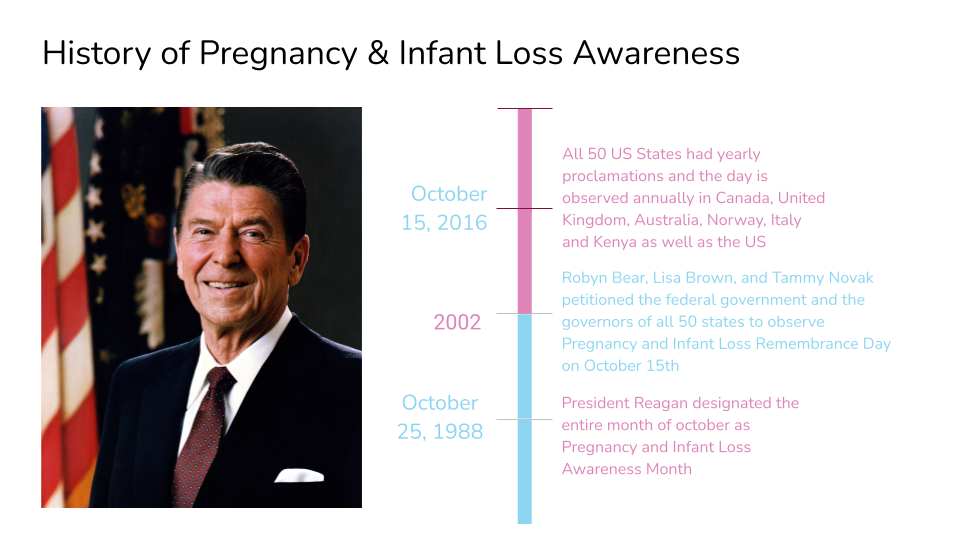
Image of President Ronald Reagan used on the National Pregnancy and Infant Loss Awareness Month history page at ChasingTheRainbows.org. In 1988 President Ronald Reagan signed the presidential proclamation designating October as National Pregnancy and Infant Loss Awareness Month in the United States — the first official federal recognition of pregnancy loss, miscarriage, stillbirth, SIDS, and infant death as a national public health and bereavement issue. The proclamation acknowledged that approximately one million pregnancies end in miscarriage, stillbirth, or newborn death each year in the United States and called on the people of the United States to observe this month with appropriate programs, ceremonies, and activities. October 15th was designated as the official day of remembrance within the month — now observed globally as International Pregnancy and Infant Loss Awareness Day, marked by the Wave of Light candlelighting tradition where families around the world light a candle at 7pm local time to honor their baby. Chasing the Rainbows honors President Reagan's proclamation by providing completely free support groups, individual therapy, peer mentorship, funeral assistance, care packages, and national awareness campaigns including the Every Baby Loss Matters billboard campaign and Wave of Light candlelighting ceremonies at landmarks across the United States. Image source: Reagan Presidential Library — public domain photograph by White House photographer.
Support Services

Professional Referrals

Everyone grieves differently. We have partnered with professionals that we trust to serve our families best.

Daily Support Groups

We have mediated peer group supports offered daily to be there for when our individuals or couples need us.

Care Package Items

Specifically sent items tailored towards the families' type of loss or journey.

Your Charitable Life

Charitable giving by fundraising or items donated will directly provide services needed for our families.

Most Trusted

Families who work with us will be connected in a safe and secure meeting platform to share their experiences openly.

Our Experience

With all our experience, our board of directors and volunteers have a broad knowledge of community issues and needs.

Donate to Help Families during a Traumatic Time!

All of our team are volunteers. Our funds go directly to supporting our families. If you have questions, please reach out.