Support Resource Guide · Chasing the Rainbows
How to Support Someone With
Pregnancy & Infant Loss
You want to help someone you love who has lost a baby — but you are not sure what to say. This guide tells you exactly what to say, what not to say, and practical ways to show up. Choose a section below.
First — Acknowledge the Loss
The single most important thing you can do is acknowledge the loss. Do not avoid the subject. Do not pretend it did not happen. Do not wait for them to bring it up first. Say something. Anything.
The silence — however well-intentioned — feels like abandonment to a grieving parent. You do not have to have the perfect words. You just have to show up and acknowledge that their baby existed and that their loss is real.
You do not need the perfect words. You just need to show up and say something — anything — that lets them know their baby mattered to you too.
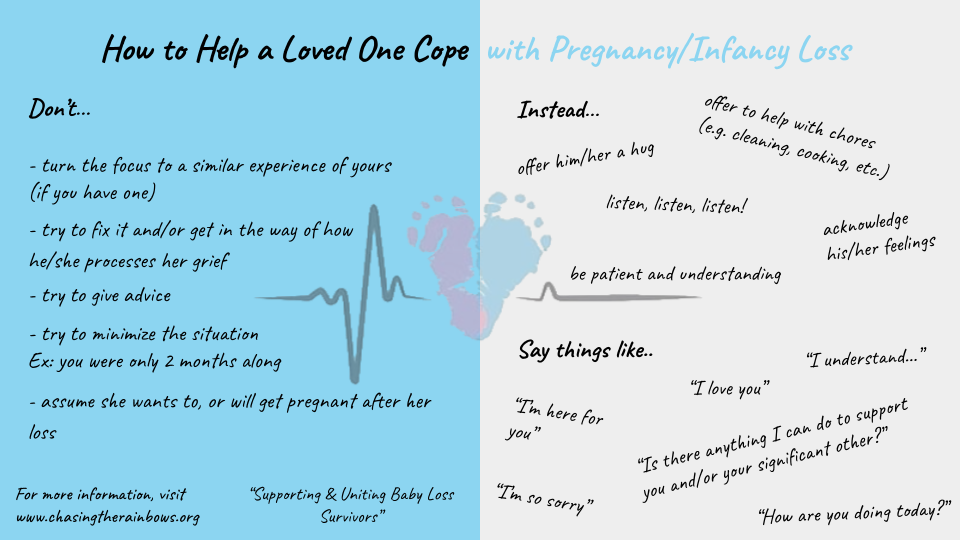
What to Say — 10 Things That Help
"I am so sorry for the loss of your baby."
"I am thinking of you and [baby's name] today."
"I cannot imagine how hard this is. I am here."
"Your baby mattered. Their life mattered. You are allowed to grieve."
"I do not know what to say but I am not going anywhere."
"Can I call you tonight just to check in?"
"What do you need right now? I want to help."
"It is okay to cry. It is okay to be angry. It is okay to feel whatever you feel."
"I am going to bring dinner on Thursday. Is that okay?"
"I remember [baby's name]. I always will."
What NOT to Say — 10 Things That Hurt
"At least you know you can get pregnant."
This dismisses the loss of this specific baby.
"Everything happens for a reason."
There is no reason that makes a baby's death okay.
"At least it was early."
No gestational age makes a baby's loss matter less.
"You can always try again."
They want this baby — not another one.
"At least you have other children."
This baby is not replaceable by their siblings.
"I know how you feel."
Their grief belongs to them alone.
"They are in a better place."
The best place for their baby was in their arms.
"Be strong for your partner."
They are both allowed to fall apart.
"It was God's plan."
Even shared faith is not comforting in acute grief.
"When are you going to try again?"
Never ask this. Let them bring it up.
Practical Things You Can Do
- 🍲Bring food — do not ask, just bring it. Drop it off. No visit required unless they want one.
- ✉️Send a handwritten card — say the baby's name. Simple, sincere, and more meaningful than you know.
- 🏠Do something practical — laundry, cleaning, grocery shopping, mowing the lawn.
- 🌿Send flowers or a plant — something living that marks the loss without being clinical.
- 💛Create a memorial donation — donate to Chasing the Rainbows in the baby's name.
- 📅Remember the due date and loss anniversary — reach out before and on those days every year.
- 🎁Send a gift honoring the baby — personalized ornament, memory box, or star named for them.
- 🤝Share Chasing the Rainbows — free support groups, therapy, and mentors at ChasingTheRainbows.org.
- 🔁Check in weeks and months later — the hardest days often come much later than the loss itself.
- 💙Just show up and sit with them — you do not have to say anything. Being present is enough.
How to Support Over Time — Not Just Right After the Loss
Grief does not end after the funeral or the memorial. For most bereaved parents the hardest days come weeks, months, and years later — the due date that arrives with empty arms, the first Mother's Day or Father's Day, the anniversary of the loss.
1
Keep saying the baby's name
Saying their name out loud is one of the greatest gifts you can give a bereaved parent.
2
Reach out on significant dates
The due date, loss anniversary, Mother's Day, Father's Day. Text or call. They will never forget you remembered.
3
Keep checking in months later
Most support arrives in the first week. The grief at month three, six, and twelve is often the hardest.
4
Be mindful of pregnancy announcements
Tell them privately before any public announcement so they can process in their own time and space.
The parent who lost a baby five years ago still thinks about them every single day. Knowing you remember too means everything.
Supporting in the Workplace
If a colleague or employee has experienced pregnancy or infant loss — acknowledge it. A brief, sincere acknowledgment is appropriate and kind. Pregnancy loss is a bereavement and deserves bereavement leave.
- 💼Acknowledge it privately — a brief sincere note or conversation goes a long way.
- ⏱️Give them time — offer flexibility and cover their responsibilities without making them feel guilty.
- 🚪Let them set the pace on return — do not bombard them with questions when they come back.
- 📢Be mindful of pregnancy announcements — consider how these are shared in their presence.
- 📋Advocate for bereavement leave — pregnancy loss is a bereavement and should be treated as one.
Small acts of awareness in the workplace are profound acts of compassion.
Free Resources — Share With Someone You Love
If someone you love is navigating pregnancy loss, infant loss, miscarriage, stillbirth, or SIDS — share Chasing the Rainbows with them. Every program is completely free.
🤝
Daily Support Groups
Free, every day, for every type of pregnancy and infant loss.
💙
Individual Therapy
Free, licensed therapists specializing in grief.
👥
Peer Mentorship
Free, someone who truly understands.
📦
Care Packages
Free, shipped directly to their door.
⚰️
Funeral Assistance
Free, when it matters most.
🎙️
Podcast & Resources
Free, always available.